
"He is just so needy,” Jane says, chasing a cherry tomato around her plate with a fork. “I mean, he either messages me five minutes after leaving the house, telling me how much he misses me already. Or, he smothers me the moment I walk in.”
Andy smiles at his older sister from across the kitchen bench. “It’s just that his Connection Cup® is so much bigger than yours.”
“What on earth is a Connection Cup?” Jane says, with her right eyebrow peaked.
“Well, if we imagine our need for love and belonging as a Cup, we would call it the Connection Cup. As your husband has a bigger need for love and belonging than you, he would have a bigger Connection Cup than you. Therefore, where you only need a little bit of love and belonging to fill and sustain your Cup, that same amount in his Cup would only half-fill it. It would not be unusual then to see him continue to choose Connection Cup-filling behaviours to try to fill the remainder of his Cup.”
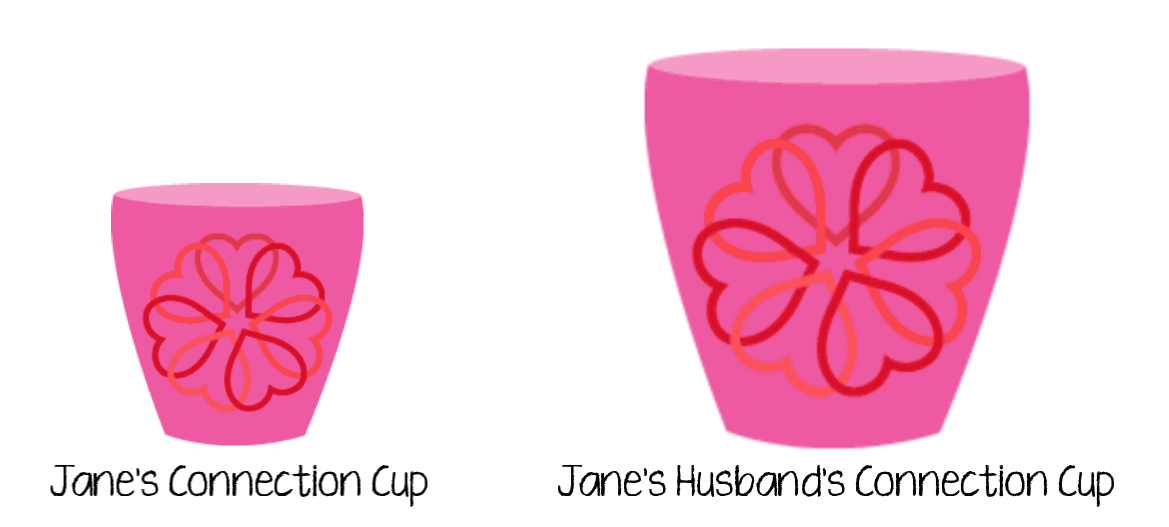
Have you ever returned home after a long day, only to feel suffocated as soon as a loved one pounces on you? Or, have you ever waited all day for your partner to finally get home, only to feel the pang of rejection when they immediately want their space?
Chances are, one of you has a larger Connection Cup than the other.
There are many reasons for these differences in behaviour, but all these reasons point to Jane's and her partner's different needs profiles (explained by The Phoenix Cups®).
Jane may also have an empty Freedom Cup® from a long day at work, and might want some Freedom Cup-filling space before she is ready to connect. Also, Jane may be filling her Connection Cup with her peers during the day, while her husband might not have those kinds of Cup-filling relationships in his life. Therefore, his Connection Cup remains less full. There is also the possibility that Jane may also be better than her husband at filling her own Connection Cup with self-love.
If this continues, it could turn into a long cycle of misunderstanding, until neither of them can remember where it all started, and all love within the relationship could be withheld. This would be disastrous.
What Now?
If Jane and her husband want to maintain a strong and healthy relationship, the key is to understand their own needs and how those needs differ from their partner's.
They can do this by determining their unique Phoenix Cups profiles. Once they know more about themselves and each other's needs, this will help them to communicate clearly and openly with each other about what it is they want. This will also help them to understand why they each choose the behaviours they choose.
Next, they'll require a Cup-filling plan to connect with one another to ensure both their needs are being met.
Finally, and importantly, both Jane and her partner need to learn to fill their own Cups. This way, their happiness will be with each other, and not dependent on each other.
Meet the author
Our clever facilitation team all write about their areas of interests that they present about in our workshops. Click through to read more about the author and see which of our professional development sessions they facilitate.

Christopher Phoenix
Phd Candidate
Wellbeing Facilitator at Phoenix Support for Educators.
Chris' dynamic keynote presentations have been described as 'hiding the vegies', as his important messages about helpful thinking, philosophy, and psychological wellbeing come with a twist of magic and a dash of hypnotic demonstration. Chris can deliver keynotes, workshop breakouts, panels, and MC.